
info@cadtraining.com.my || info@caddesignschool.com
Phone
0380630414 01173052587 014-6491168
Location
3rd Floor, 27 Jalan Puteri 4/6, Bandar Puteri, 47100 Puchong, Selangor
info@cadtraining.com.my || info@caddesignschool.com
Phone
0380630414 01173052587 014-6491168
Location
3rd Floor, 27 Jalan Puteri 4/6, Bandar Puteri, 47100 Puchong, Selangor
Many organisations collect and manage personal data every day, but not every team fully understands how PDPA compliance, the Personal Data Protection Act, and cybersecurity responsibilities affect their daily decisions. From employee records and customer databases to vendor information, payroll details, biometric data, phishing threats, ransomware risks, and breach reporting obligations, one small mistake can expose the organisation to legal, financial, and reputational consequences.
This PDPA Compliance & Cybersecurity Training helps participants understand the practical requirements of the Personal Data Protection Act, PDPA 2024 Amendments, and Cyber Security Act 2024 in a clear and workplace-focused way. Instead of only focusing on theory, the programme guides employees, managers, Data Protection Officers, HR personnel, IT teams, compliance officers, and business leaders on how to recognise data protection risks, manage personal data securely, strengthen cybersecurity practices, support audit readiness, and respond effectively when a data breach occurs.
Participants may choose between the 2-Day Mandatory PDPA Compliance & Cybersecurity Essentials Programme or the 3-Day PDPA & Cybersecurity Practitioner Programme with 72-Hour Breach Response Simulation. Both programmes are designed to build practical awareness in privacy, security, accountability, and responsible data handling, while the 3-day practitioner course includes a more advanced breach response simulation covering reportability assessment, response team activation, regulatory notification, individual communication, and the 72-hour breach response process.
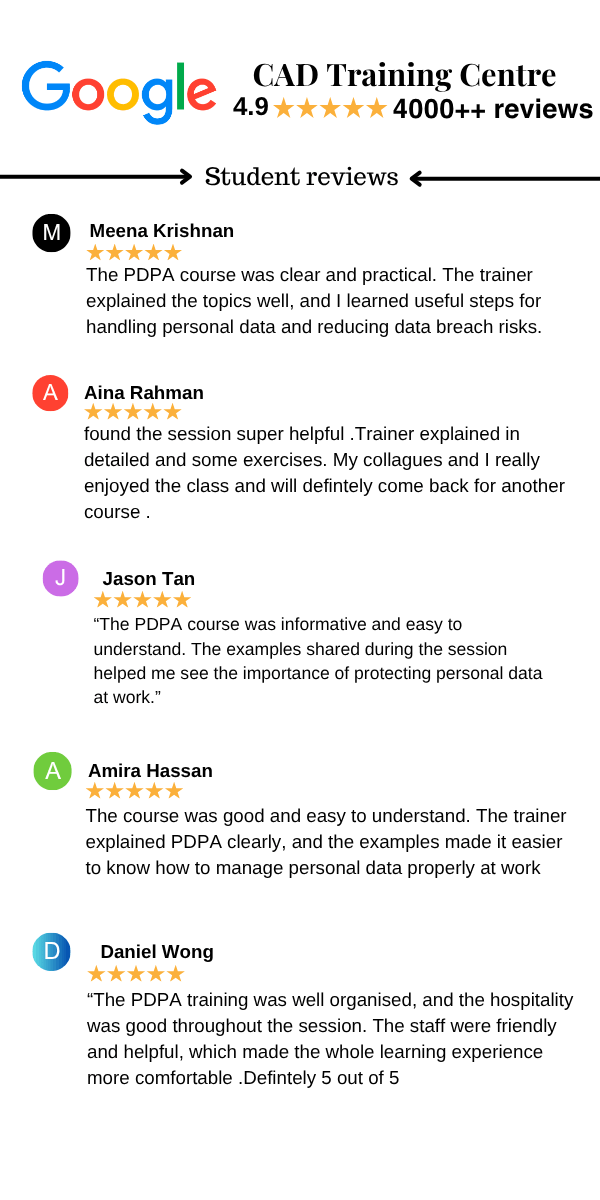
(4000++ ⭐⭐⭐⭐⭐Google Reviews)

This PDPA Compliance & Cybersecurity Training Course is a practical data protection programme designed to help participants understand, prevent, detect, and respond to personal data protection and cybersecurity risks in daily business operations.
The course covers key compliance areas including the Personal Data Protection Act (PDPA) 2024 Amendments, Cyber Security Act 2024, mandatory breach notification, 72-hour breach response, Data Protection Officer responsibilities, Data Protection Impact Assessment (DPIA), audit readiness, cyber hygiene, access control, ransomware risks, phishing threats, and incident response planning.
Through scenario-based discussions, real-world case studies, interactive Q&A, practical activities, and breach response simulation, participants will gain practical skills to strengthen data privacy, cybersecurity awareness, regulatory compliance, audit preparation, and responsible handling of personal data across the organisation.
Understand how PDPA compliance, the Personal Data Protection Act, and cybersecurity risks apply to daily business operations, especially when handling customer, employee, vendor, and business data.
Learn key concepts linked to the PDPA 2024 Amendments, Cyber Security Act 2024, mandatory breach notification, Data Protection Officer responsibilities, and 72-hour breach response requirements.
Recognise common risks such as data leaks, weak access control, phishing attacks, ransomware threats, poor data handling, vendor exposure, and employee data misuse.
Apply practical safeguards such as access control, multi-factor authentication, encryption, least privilege access, internal policies, audit trails, and cyber hygiene practices.
Learn how to collect, store, use, share, and protect personal data responsibly in line with the Personal Data Protection Act and workplace privacy expectations.
Understand how to identify potential data breaches, document incidents, maintain a breach register, escalate issues internally, and report within the required 72-hour window.
Learn the basics of incident response planning, evidence preservation, breach classification, notification preparation, and audit preparation for PDPC or cybersecurity-related checks.
Connect PDPA compliance, cybersecurity, HR, IT, operations, risk management, vendor management, and governance into one practical approach for protecting personal data across the organisation.
Participants will gain practical workplace-ready tools and guidance to support PDPA compliance, cybersecurity awareness, audit readiness, and data breach response. This includes a clearer understanding of personal data protection requirements, incident response planning, breach documentation, 72-hour notification preparation, and practical cybersecurity controls that can be applied across the organisation.
This PDPA Compliance & Cybersecurity Training Course is suitable for business owners, directors, managers, Data Protection Officers, HR and admin teams, IT personnel, compliance officers, risk officers, legal teams, and operations leaders who handle personal data or are responsible for data protection, cybersecurity, audit readiness, and breach response.
It is especially useful for organisations that manage customer data, employee records, payroll information, biometric data, vendor details, or sensitive business information, and want to strengthen compliance with the Personal Data Protection Act (PDPA) and cybersecurity requirements.
It is especially recommended for:
This Mandatory PDPA Compliance & Cybersecurity Essentials Training is a 2-day course designed to help organisations understand their responsibilities under the Personal Data Protection Act (PDPA) 2024 Amendments and the Cyber Security Act 2024.
Participants will learn how to manage personal data responsibly, identify data protection and cybersecurity risks, prepare for audit readiness, and respond to data breach incidents, including the mandatory 72-hour breach notification process. The course also covers DPO responsibilities, DPIA, breach registers, cyber hygiene, access control, phishing, ransomware, and incident response planning.
Course Summary:
This PDPA & Cybersecurity Practitioner with 72-Hour Breach Response Simulation is a 3-day training programme designed to help organisations understand and apply the requirements of the Personal Data Protection Act (PDPA) 2024 Amendments and the Cyber Security Act 2024.
The course covers PDPA compliance, mandatory breach notification, Data Protection Officer responsibilities, DPIA, cybersecurity safeguards, audit readiness, and incident response planning. Participants will also take part in a practical 72-hour breach response simulation, where they learn how to assess breach severity, activate a response team, prepare notification reports, and manage a data breach scenario effectively.

| Course | Normal Price | Promo Price |
|---|---|---|
| Mandatory PDPA Compliance & Cybersecurity Essentials (2 days) | RM2500 + 8% SST | RM1890 + 8% SST |
| PDPA & Cybersecurity Practitioner with 72-Hour Breach Response Simulation (3 days) | RM3500 + 8% SST | RM2890 + 8% SST |
Watch our PDPA video resources to understand the basics of personal data protection, cybersecurity awareness, and responsible data handling in the workplace.
These videos are designed to give a simple overview of PDPA compliance, data breach risks, audit readiness, and the importance of protecting customer, employee, and business information.

✔️ Beginner-friendly. We start from zero, so you don’t need any prior background. Ask anything, anytime — our trainers are patient, approachable, and genuinely here to help you.
✔️ Walk away with a real strategy. Not just theory, but a practical plan you can use in your workplace the very next day. That’s what makes our ABAC Training different.
✔️ Certificate included. You’ll get something solid to show for your effort and commitment.
✔️ Free repeat classes (for face-to-face learners). We’d rather you really understand after attending, than rush through just for the sake of it.
✔️ Online learners? Don’t worry — you’ll get the class recording to revisit anytime you need a refresher.
🖥️ No laptop? No problem. We provide one during class so you can focus fully on learning.
📚 Complete training manual included. Everything in one place, step by step, so you won’t get lost after class.
🌟 Proven track record. Over 4000 ++ glowing Google Reviews — CAD Training Centre is a trusted place to learn, and this Anti-Bribery & Anti-Corruption, Anti-Money Laundering, and Human Rights course is no exception.
For this Personal Data Protection Act Training Malaysia, our facility is situated in Bandar Puteri, Puchong and is just a 2-minute walk from the Bandar Puteri LRT.

Bandar Puteri, Puchong
There is also a parking complex that’s only a 3-minute walk to and fro our Training Centre, making sure that participants do not have to worry about taking a hike just to reach the CAD Training Centre. There are also numerous restaurants nearby, with options to match!
Our training sessions are held in a classroom setting. In the leadership course Malaysia, the instructor teaches the theory and shows various practical examples.
Participants also get to try out numerous exercises and experience the learning-by-applying concept.
The training style consists of 70% practical and 30% theory, workshop style. We intend that students learn more by doing rather than just listening.
You will receive personal guidance from our trainers during the class.
Our trainers will have Q&A sessions to answer the various questions throughout the class.
Our typical class size is between 6-10 students. This setup allows our trainers to spend more time with each of their students.
We offer in-house training programmes based on the participants request. Our trainer will conduct the training in the location of your choosing.
Yes, all of our courses–including this Leadership Training are HRDF claimable. If you don’t know how to apply for HRDF (Under SBL-Khas), you can refer to this guide here!
Yes, participants will receive a certificate of completion by the end of the PDPA course, which is useful for HRD corp. claims and professional development records.
This course trains participants through practical, scenario-based learning using real business situations instead of heavy technical theory. Participants learn by discussing cases, identifying red flags, joining group challenges, completing simulations, role-playing whistleblowing situations, and applying compliance controls to workplace scenarios.
The training also includes scenario-based discussions, real-world case studies, interactive Q&A, incident response planning, and a 72-hour breach response simulation to help participants apply PDPA compliance, cybersecurity safeguards, Data Protection Officer responsibilities, breach notification procedures, audit readiness, and personal data protection practices in daily business operations.
This is a 2-day course from 9:00 AM – 5:00 PM, including breaks and hands-on group activities.
Yes, participants will receive handouts, and references for immediate use at work or to refresh their knowledge.
