3rd Floor, 27 Jalan Puteri 4/6, Bandar Puteri, 47100 Puchong, Selangor
Fundamentals of Global Logistics & Supply Chain Management
Looking to understand how products move from one country to another, or how businesses get what they need on time? Our Fundamentals of Global Logistics & Supply Chain Management course is designed just for you! In this easy-to-follow course, you’ll learn about the basics of logistics and how supply chains work in the real world. We’ll break things down step by step to make sure you understand how goods are shipped, stored, and delivered around the world.
Whether you’re new to the field or just want to learn more, this course is the perfect place to start! You’ll gain the skills you need to improve processes in your business, reduce costs, and manage resources better. Join us and take your first step into understanding how global logistics keeps the world moving!
Master the Fundamentals of Global Logistics & Supply Chain Management (2 Day Course)
Are you looking to build a strong foundation in global logistics and supply chain management? Our Fundamentals of Global Logistics & Supply Chain Management (2 Days) course is designed for professionals who want to understand the key elements of logistics processes and effectively navigate the global supply chain ecosystem. This course covers everything from managing logistics processes to complying with international trade regulations, helping you enhance performance and manage risks within your organization.
Through this training, you’ll learn about regulatory requirements like Incoterms and customs compliance, build resilience in your supply chain with cutting-edge performance management techniques, and discover how to incorporate sustainability into your logistics strategies. Whether you’re managing supply chains, overseeing procurement, or optimizing global trade operations, this course will equip you with the skills to stay ahead in today’s fast-paced global market.
Who is it for? This course is ideal for:
Logistics and Supply Chain Professionals
Procurement Specialists
Managers involved in Global Trade and Transportation
Individuals aiming to optimize their supply chain operations
Duration: 2 Days
Cost: Normal price RM2450 – *Promotional Price* RM1750
Day 1: Understanding Global Logistics and Supply Chain Management (GLSCM)
Introduction to GLSCM
Logistics vs SCM
Demand Management
Demand Forecasting
Demand Planning Techniques
Procurement
Strategic Sourcing
Supplier Relationship Management
Order Management & Customer Service
Order Processing
Enhancing Customer Service
Warehousing & Inventory Management
Warehouse Operations
Inventory Control
Transportation
Modes of Transport
Route Planning
Distribution
Channel Strategies
Network Optimization
Managing Reverse Flows
Reverse Logistics
Return and Waste Management
Day 2: Mastering Regulatory Requirements & Building GLSCM Resilience
International Trade & Incoterms
Overview of Incoterms
Incoterms in Trade Transactions
Customs Compliance
Customs Procedures
Trade Compliance
Security & Safety
Security in GLSCM
Safety Protocols
Performance Management
Key Performance Indicators
Monitoring and Improving GLSCM
Risk Management & Problem Solving
Identifying Risks
Problem-Solving Techniques
Efficiency & Cost Optimization
Process Improvement
Reducing Costs
Use of Technology in GLSCM
AI and Automation
Data Analytics in Logistics
Managing Ethics & Sustainability
Ethical Practices
Sustainable Supply Chain Practices
Learning Outcomes
Day 1: Understanding Global Logistics and Supply Chain Management (GLSCM)
Introduction to GLSCM Understand the foundational concepts of global logistics and supply chain management.
Logistics vs SCM Distinguish between logistics and supply chain management and their respective roles.
Demand Management Implement effective demand forecasting and planning techniques to meet customer needs.
Procurement Develop skills in strategic sourcing and managing supplier relationships for optimal procurement.
Order Management & Customer Service Enhance order processing efficiency and improve customer service levels.
Warehousing & Inventory Management Master warehouse operations and inventory control practices for effective management.
Transportation Evaluate modes of transport and apply route planning strategies.
Distribution Analyze channel strategies and optimize network distribution.
Managing Reverse Flows Implement practices in reverse logistics and waste management.
Day 2: Mastering Regulatory Requirements & Building GLSCM Resilience
International Trade & Incoterms Navigate and apply Incoterms in trade transactions to ensure compliance.
Customs Compliance Understand and execute customs procedures and trade compliance measures.
Security & Safety Identify and apply security and safety protocols within GLSCM.
Performance Management Utilize key performance indicators for monitoring and enhancing GLSCM performance.
Risk Management & Problem Solving Develop strategies to identify risks and implement problem-solving techniques.
Efficiency & Cost Optimization Implement process improvements aimed at reducing costs and enhancing efficiency.
Use of Technology in GLSCM Assess the impact of AI, automation, and data analytics on logistics operations.
Managing Ethics & Sustainability Integrate ethical practices and sustainable methods into supply chain strategies.
Enrol Today
Begin your journey in mastering Mastering Global Logistics and Supply Chain Course today. Getting started is easy; just click an option below:
Take the next step in your journey to mastering global logistics and supply chain management. Gain the essential skills to navigate complex international regulations, improve operational efficiency, and position your organization for success in today’s fast-evolving global market.
Class Duration and Schedule
Our classes start at 9:00 am to 5:00 pm with regular breaks. These breaks give the participants time to rest and to process the information that they receive during the course.
**Free Repeats**
To help our participants better, we offer free repeat classes. Students can revisit the institute and refresh their skills if needed. These free repeat classes are available every month.
Our training centre is located in Bandar Puteri, Puchong and is only a 2-minute walk from the Bandar Puteri LRT station with many restaurants nearby. For those who drive, nearby there is a shaded car park which is free. Due to its proximity, our centre gets many students from Kuala Lumpur and Klang Valley.
Our training sessions are held in a classroom setting. The instructor teaches the theory and shows various practical examples.
Participants also get to try out numerous exercises and experience the learning-by-applying concept.
You will receive personal guidance from our trainers during the class.
Our trainers will have Q&A sessions to answer the various questions throughout the class.
Our typical class size is between 12-15 students. This setup allows our trainers to spend more time with each of their students.
Online Training
Our online classes are conducted via digital platforms such as Zoom and Cisco Webex. Classes are both exciting and relaxed as our trainers have a lively approach that works well for online training. We also designed the lessons to promote ease of learning.
Our experienced trainers will teach and guide the students with practical hands-on exercises that are done via screen sharing.
Because there are no geographic limitations, our students are from all over Malaysia.
In-house and Corporate Training
We also conduct in-house training programmes based on request.
Why Choose Us
Free Repeats & Tutorials
We offer free unlimited repeats, no questions asked.
In rare instances, some students are unable to digest all the information at one go and may need a refresher.
Also, we have our students’ best interests at heart and want them to leave the class with full confidence.
Upon completing the course, we also provide free online tutorials for your continuous learning.
Professional Certification
Upon completing the Fundamentals of Global Logistics and Supply Chain Management course, a Certification of Achievement will be issued.
We are known for our tagline “Start from zero!” – students do not need any prior knowledge or experience to take our basic courses.
Conducive Learning Experience
Our classes focus on the practical aspects and less about theory to the ratio of 70:30 – we found that this approach helps with learning and remembering.
Our class sizes are small at about 12-15 pax per session, and this gets each student more attention from the trainer.
Learning Aids
We provide laptops during the classroom sessions for your convenience.
During your training, a handbook will be given for your reference.
Meal options are also provided.
Our intention is for you to focus on the training and not worry about what to bring to class.
Frequently Asked Questions
FAQ for Fundamentals of Global Logistics and Supply Chain Management Course in Malaysia
What is supply chain management, and why does it matter for my business in Malaysia?
Supply chain management ensures that products get from suppliers to customers efficiently. In Malaysia, managing this well helps businesses reduce costs, meet customer demands, and stay competitive, especially when sourcing from or selling internationally.
How can I improve my logistics processes as a Malaysian entrepreneur? Start by analyzing your current system, including transportation, inventory, and delivery. Adopting technology, such as automation tools, and working with reliable logistics partners can help you reduce errors, cut costs, and speed up deliveries.
What are the benefits of using third-party logistics (3PL) providers in Malaysia?
3PL providers handle various logistics tasks like warehousing, shipping, and customs clearance. For small and medium businesses in Malaysia, using 3PL services can help reduce operational burdens and improve supply chain efficiency.
What is the importance of Incoterms in Malaysia for global trade? Incoterms define the responsibilities of buyers and sellers in international trade. Knowing them helps Malaysian businesses avoid misunderstandings in contracts, reduce risks, and ensure smooth cross-border transactions.
How can my business ensure compliance with Malaysian customs regulations?
Make sure you understand the Malaysian customs rules and requirements for importing and exporting goods. Hiring a customs broker or working with experienced logistics providers can help you stay compliant and avoid delays or fines.
What are the biggest logistics challenges faced by businesses in Malaysia? Common challenges include navigating complex customs regulations, managing transport delays, dealing with infrastructure issues, and keeping up with the cost of fuel and other resources. Planning ahead and having backup suppliers can help reduce these risks.
How can technology improve supply chain management for my business in Malaysia?
Technology like real-time tracking, inventory management software, and predictive analytics can give you better visibility into your supply chain. This can help you make faster, data-driven decisions, reduce costs, and improve delivery times.
What strategies can help Malaysian businesses build a resilient supply chain?
Diversifying suppliers, using local vendors where possible, and investing in technology to monitor risks are key strategies. Additionally, building strong relationships with suppliers helps ensure smoother operations during disruptions.
How can small businesses stay competitive in global logistics?
Small businesses can compete by using digital platforms, automating processes, and outsourcing non-core logistics tasks to experts. Joining industry associations and staying updated on the latest trends also helps stay ahead in a competitive market.
What role does sustainability play in supply chain management for Malaysian businesses?
Incorporating sustainability in logistics—like using eco-friendly packaging, reducing carbon emissions, or sourcing from sustainable suppliers—can enhance your brand reputation, meet consumer demand, and help you stay compliant with evolving global regulations.
What is the difference between classroom learning vs online courses?
Classroom Learning
Participants will attend the course at the training centre in Bandar Puteri, Puchong.
Face to Face Interaction with the trainer in a classroom setting.
Immediate guidance & attention from the trainer
More focused
Learning among other participants during exercises
Online Course
Participants will attend the course using online platforms such as Zoom and Cisco Webex
Can save on travel and food expenses
Learn from the comfort of your own home/office
More flexibility
Able to discuss with people from different companies.
What Participants Say
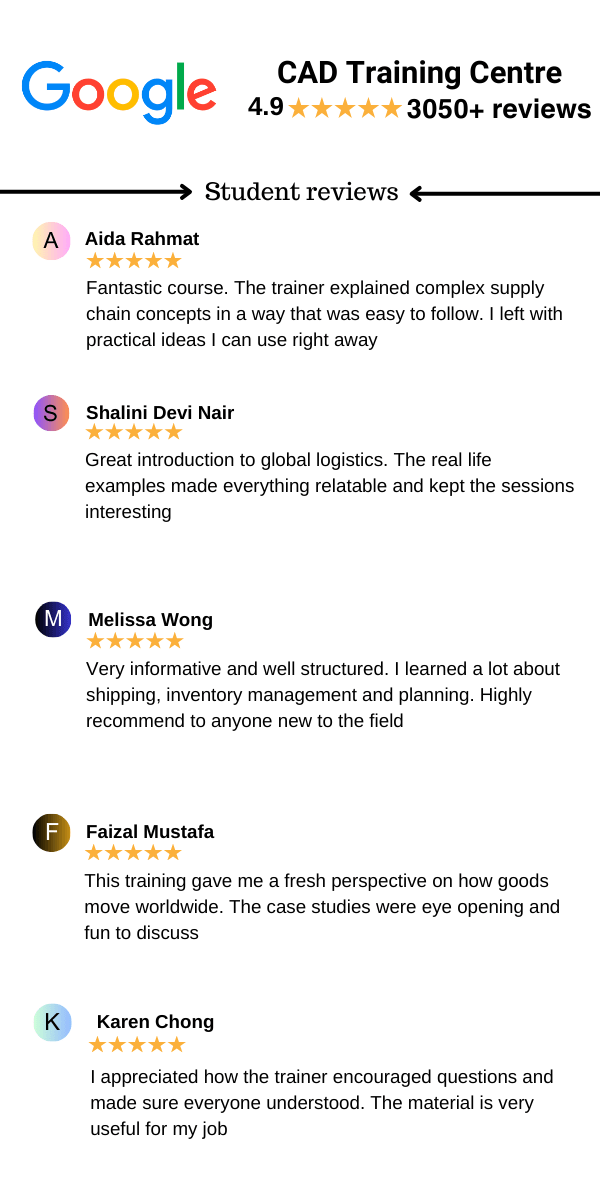
We have trained many well-known companies and individuals who completed their course highly satisfied. We feel honoured to receive their encouraging feedback and positive reviews.